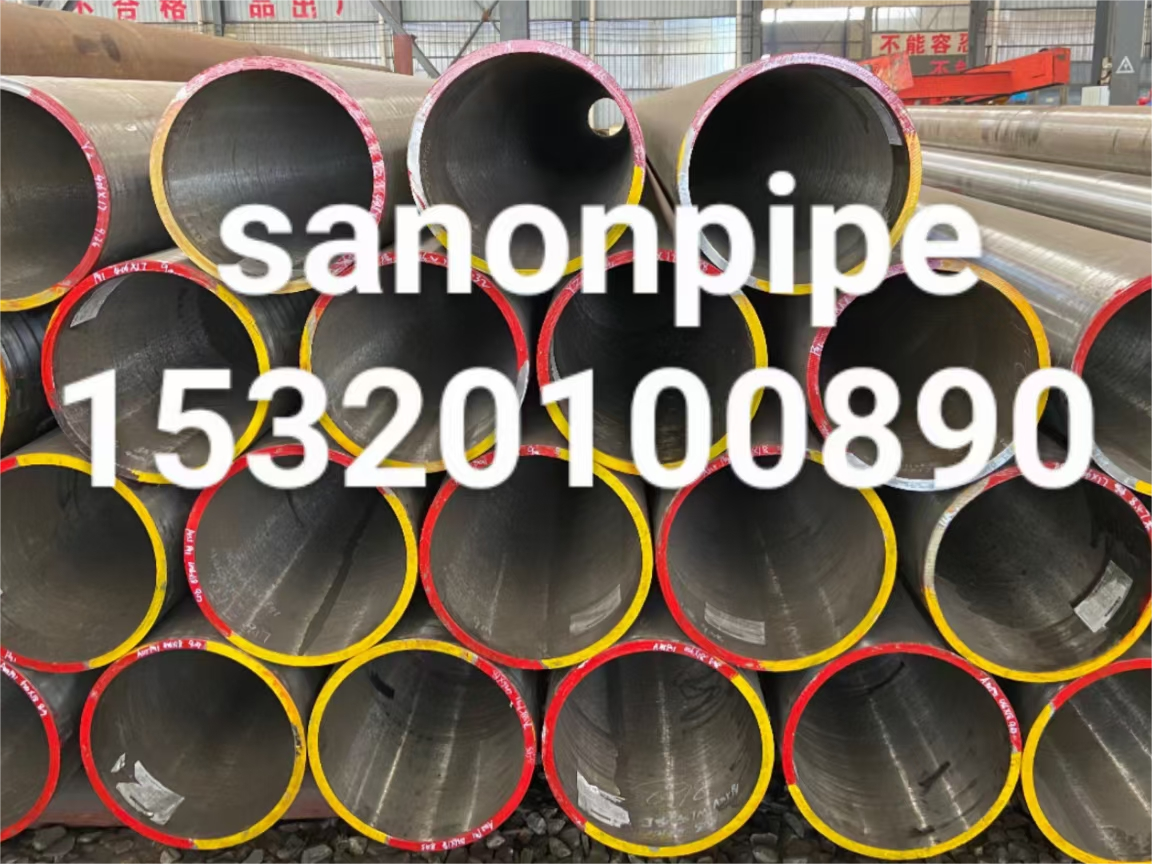
Alloy Steel Pipe P9: A High-Temperature Workhorse
If you want to know more information, like quotation, products, solutions, etc., please contact us online.
Tianjin Sanon Steel Pipe Co., Ltd. is a stockist. Our stock factory is in Cangzhou City, Hebei Province. Our main sources of goods are boiler pipes, and the representative materials are ASTM A335 P5/P11/P91/P92, ASME SA-106/SA-106M GR.B, GB/T 3087-2008 10#/20#. The representative materials of pipeline pipes are API 5L, API 5CT, the representative materials of petroleum cracking pipes GB/T 9948 are 15MoG/12CrMoVG. GB/T 6479-2013 represents the material 10#/20#, heat exchanger tubes SA179/SA210/SA192, etc., mechanical tubes GB/T 8162 represent the material 10#/20#/Q345/42CrMo, EN10210 represents the material S355JOH/S355J2H, gas cylinder tubes GB1 8248, represent the material 34CrMo4/30CrMo.
Introduction
In the demanding world of industrial piping, where high temperatures and corrosive environments are the norm, material selection is paramount. Among the various chromium-molybdenum (Cr-Mo) alloy steels, P9 stands out as a reliable and specialized material designed for elevated temperature service. Alloy Steel Pipe P9 is a cornerstone in applications ranging from power generation to petroleum refining, valued for its unique combination of strength, oxidation resistance, and microstructural stability.
What is Alloy Steel Pipe P9?
P9 pipe is a designation from the ASTM (American Society for Testing and Materials) A335 standard, which covers seamless ferritic alloy-steel pipe for high-temperature service. The “P” denotes pipe, and “9″ refers to its specific chemical composition, which is centered around 9% chromium and 1% molybdenum. This specific chemistry is the key to its performance.
Key Characteristics and Composition
The properties of P9 steel pipe are derived from its precise alloying elements:
• Chromium (Cr ~9%): This is the primary element that provides enhanced resistance to oxidation (scaling) and corrosion, particularly in sulfur-bearing environments. It forms a stable, protective chromium oxide layer on the surface of the steel.
• Molybdenum (Mo ~1%): Molybdenum significantly increases the strength of the steel at high temperatures. It helps prevent creep, a slow, continuous deformation of material under constant stress at elevated temperatures.
This composition gives P9 pipes several critical advantages:
• Excellent High-Temperature Strength: P9 maintains its mechanical integrity and load-bearing capacity at temperatures typically up to 1100°F (593°C), making it suitable for high-pressure steam and process lines.
• Good Oxidation Resistance: The 9% chromium content provides a substantial improvement in oxidation resistance compared to lower alloy steels like P11 or P22.
• Enhanced Creep Rupture Strength: Its ability to withstand long-term exposure to high stress and temperature without failing is a key reason for its use in critical applications.
• Microstructural Stability: The alloy is designed to resist the formation of undesirable phases that can embrittle the steel over time during high-temperature service.
Typical Applications
Alloy Steel P9 pipes are predominantly used in industries where high temperatures are a constant factor:
• Power Generation: Superheater and reheater tubes, main steam lines, and other high-temperature piping systems in fossil-fuel power plants.
• Petrochemical and Refining: Transfer lines in refineries, heater tubes, and piping for processes involving high-temperature hydrocarbons.
• Chemical Processing: For conveying process streams at elevated temperatures where corrosion resistance is also required.
Advantages Over Other Alloys
While there are many Cr-Mo alloys, P9 occupies a specific niche. It offers better oxidation resistance and higher strength than the more common 2.25% Cr (P22) alloy, without the significantly higher cost and welding complexity of the 9-12% Cr (P91) family. This makes P9 a cost-effective and technically sound choice for many intermediate temperature applications.
Conclusion
Alloy Steel Pipe P9 is a proven and indispensable material for engineers designing high-temperature piping systems. Its balanced composition of 9% chromium and 1% molybdenum delivers an optimal blend of strength, oxidation resistance, and durability. For applications where reliability under thermal stress is non-negotiable, P9 continues to be a trusted and high-performing solution.